Forex Basics · Beginner Guide
What Is a Pip in Forex? How to Calculate Pips and Pip Value
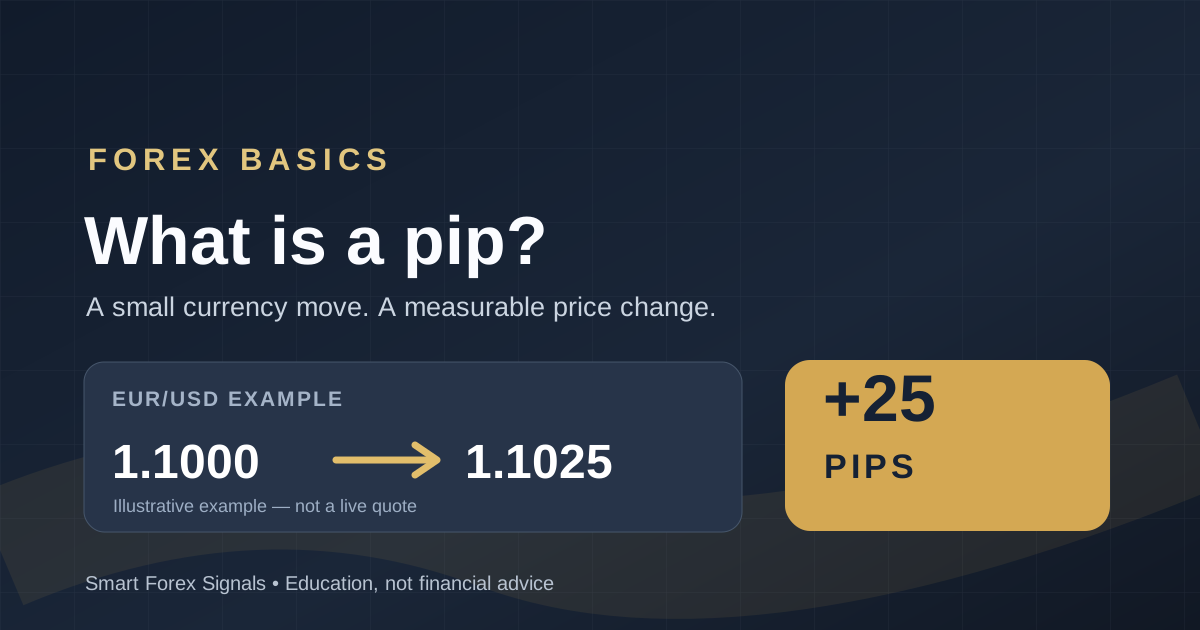
The difference between 1.1000 and 1.1025 may look small. In forex terminology, that is a 25-pip move. Here is how to count it, turn it into a position value and avoid common decimal-place mistakes.
· By Andreas · Educational guide
Quick answer: What is a pip?
A pip is a standard way to measure a currency pair's price movement. For most major currency pairs, 1 pip = 0.0001 of the quoted exchange rate. For yen-quoted pairs such as USD/JPY, 1 pip = 0.01. The money value of a pip depends on position size and the currencies involved.
Why forex prices use pips
Forex exchange rates are expressed as pairs. In EUR/USD, the euro is the base currency and the US dollar is the quote currency. A quote of 1.1000 means that one euro is priced at 1.1000 US dollars. A small change in the quote can be described in pips instead of reading every decimal place aloud.
That terminology helps compare the size of price movements, bid–ask spreads and stop distances. But a 20-pip move is not automatically a $20 profit or loss. Pip movement measures distance; your position size determines its monetary impact.
How to count pips: EUR/USD example
Imagine EUR/USD moves from 1.1000 to 1.1025. Since one pip equals 0.0001, the calculation is:
(1.1025 − 1.1000) ÷ 0.0001 = 25 pips
An upward change of 0.0025 is 25 pips.
If EUR/USD instead falls from 1.1000 to 1.0980, the price change is −0.0020, or 20 pips down. A short position could benefit from falling prices, while a long position would move against the trader before transaction costs. These are hypothetical price examples, not trade recommendations.
USD/JPY and other yen pairs: the exception
In the usual pricing convention, USD/JPY is counted in hundredths of a yen rather than ten-thousandths. Suppose USD/JPY changes from 150.00 to 150.25. Because one pip is 0.01:
(150.25 − 150.00) ÷ 0.01 = 25 pips
These are illustrative rates, not current quotes.
| Currency pair | Typical pip size | Example 1-pip movement |
|---|---|---|
| EUR/USD | 0.0001 | 1.1000 → 1.1001 |
| GBP/USD | 0.0001 | 1.2500 → 1.2501 |
| USD/JPY | 0.01 | 150.00 → 150.01 |
| EUR/JPY | 0.01 | 160.00 → 160.01 |
Different brokers may display more digits or define platform-specific "points" differently. Always check the instrument specification instead of guessing from the number of visible decimals.
Interactive example
Pip movement calculator
Change the fictional prices to see the number of pips and the theoretical gross price movement of a position. Nothing is sent to a broker.
Movement for your position
+25.0 pips
Value of 1 pip in quote currency
1.00 USD
Illustrative gross position result
+25.00 USD
Based on 10,000 units of the base currency. Before spreads, fees, slippage and financing charges.
Educational arithmetic only. USD conversion for USD/JPY uses the example exit rate, and actual broker contract conventions and execution prices may differ. This is not an order ticket or investment recommendation.
How much is one pip worth in dollars?
To calculate pip value, multiply the pip size by the number of units of the base currency in your position. The initial answer is denominated in the quote currency. Convert it if your trading account uses a different currency.
For EUR/USD, which is quoted in US dollars, the familiar examples are:
| Position | Base units | 1-pip value | 20-pip move |
|---|---|---|---|
| Standard lot (1.00) | 100,000 EUR | $10.00 | $200.00 |
| Mini lot (0.10) | 10,000 EUR | $1.00 | $20.00 |
| Micro lot (0.01) | 1,000 EUR | $0.10 | $2.00 |
These figures represent the gross sensitivity of the position to an exchange-rate move. They do not include spreads, commissions, financing, slippage or any broker-specific contract differences. Read our forex risk management guide before using pip values for position sizing.
Why one pip is not always worth $10
The $10 example applies to a standard 100,000-unit EUR/USD position when you are measuring results in USD. On USD/JPY, a standard lot has a pip value of ¥1,000 (100,000 × 0.01). At a hypothetical USD/JPY exchange rate of 150.00, this is approximately $6.67 per pip (¥1,000 ÷ 150.00). Its USD value changes as the exchange rate changes.
For another pair such as USD/CHF, a standard-lot pip is initially denominated in Swiss francs, not US dollars. Conversion is needed to express that value in a USD-denominated account. Do not apply the EUR/USD dollar rule to every forex pair.
Pips versus pipettes: what is the fifth decimal?
Some forex quotes include an extra digit. For EUR/USD, a quote might read 1.10256. The fourth decimal place represents the conventional pip; the fifth represents a pipette, or one-tenth of a pip. A price change from 1.10250 to 1.10256 is six pipettes, equal to 0.6 pips.
For USD/JPY, the conventional pip is the second decimal and the pipette is usually the third. A shift from 150.250 to 150.256 is six pipettes rather than six full pips. Depending on the platform, the word "point" may refer to the smallest displayed digit, so confirm the broker's terminology.
How pips relate to spreads and trading costs
A broker commonly displays two prices for a currency pair: the bid and the ask. Imagine EUR/USD is quoted at 1.0999 / 1.1001. The difference of 0.0002 equals a 2-pip spread. A trader buying at the ask and immediately selling at the bid would lose approximately two pips before any other charges or slippage.
That is why a profitable-looking movement on a chart does not guarantee a profitable realized trade. Real executions use actual bid and ask prices, may have additional commissions and can differ from expected fills in fast markets. Broker regulation, funding rules and trading costs matter as much as any advertised spread; see our US broker comparison.
Using a pip distance to think about risk
Suppose a hypothetical trader considers a stop distance of 20 pips on EUR/USD. For a 0.10-lot position, one pip is approximately $1. A 20-pip adverse move therefore represents $20 in gross price movement before spread, commissions or slippage. A 1.00-lot position would have ten times the same gross exposure.
The lesson is not to choose a specific lot size or stop distance. It is to calculate what a potential move means in account currency before taking any risk. Leveraged forex can magnify losses rapidly. The US Commodity Futures Trading Commission warns that many retail forex customers lose money and emphasizes checking dealer registration and understanding margin requirements.
For more background, read how forex leverage and margin work and our beginner guide to forex trading.
Common pip mistakes beginners can avoid
- Confusing pips with currency units: a 10-pip move is a measure of price change, not a fixed $10 profit.
- Counting the wrong decimal: most major pairs use 0.0001; yen-quoted pairs generally use 0.01.
- Ignoring pipettes: a fifth decimal in EUR/USD usually counts tenths of a pip.
- Forgetting the quote currency: USD/JPY pip values are in JPY until converted into USD or another account currency.
- Ignoring trading costs: spreads, commissions and financing can turn a gross gain into a net loss.
- Applying examples blindly: contract sizes and quoting conventions may vary by broker and product.
Frequently asked questions
What is one pip in EUR/USD?
Under the standard forex convention, one pip in EUR/USD is 0.0001. A move from 1.1000 to 1.1001 is one pip.
How many pips is a change from 1.1000 to 1.1025?
The difference is 0.0025. Dividing it by 0.0001 gives 25 pips.
What is one pip worth on a standard lot?
For a 100,000-unit EUR/USD position, one pip is $10 in the quote currency, USD. Other pairs and account currencies may require conversion.
Is a pip the same as a pipette?
No. A pipette is one-tenth of a pip. EUR/USD pipettes are typically 0.00001, while USD/JPY pipettes are typically 0.001.
Why is the pip size different for USD/JPY?
Currency pairs quoted in Japanese yen generally use 0.01 per pip under the standard convention, compared with 0.0001 for most other major pairs.
Sources and further reading
Definitions and numerical conventions were cross-checked against broker education materials and a US regulator's forex-risk guidance. Sources do not endorse this article or the products discussed on this site.
- OANDA US — What is a pip in trading?
- IG — Pips in forex: definitions and lot examples
- CFTC — Eight things you should know before trading forex
Risk and affiliate disclosure: This page is educational, not personalized financial advice. Trading on margin can lead to substantial losses. Some other pages on this website contain affiliate links; seller claims are not guaranteed or independently validated merely because they are linked.