0DTE Options Risks: What No One Tells You About Zero-Day Trading
Published March 29, 2026
0DTE options — zero-days-to-expiration contracts that expire within the same trading day — have exploded in popularity. In 2024, 0DTE options made up over 40% of SPX volume, according to Cboe Global Markets data. But behind the hype lies a minefield of risks that destroy more retail accounts than they create.
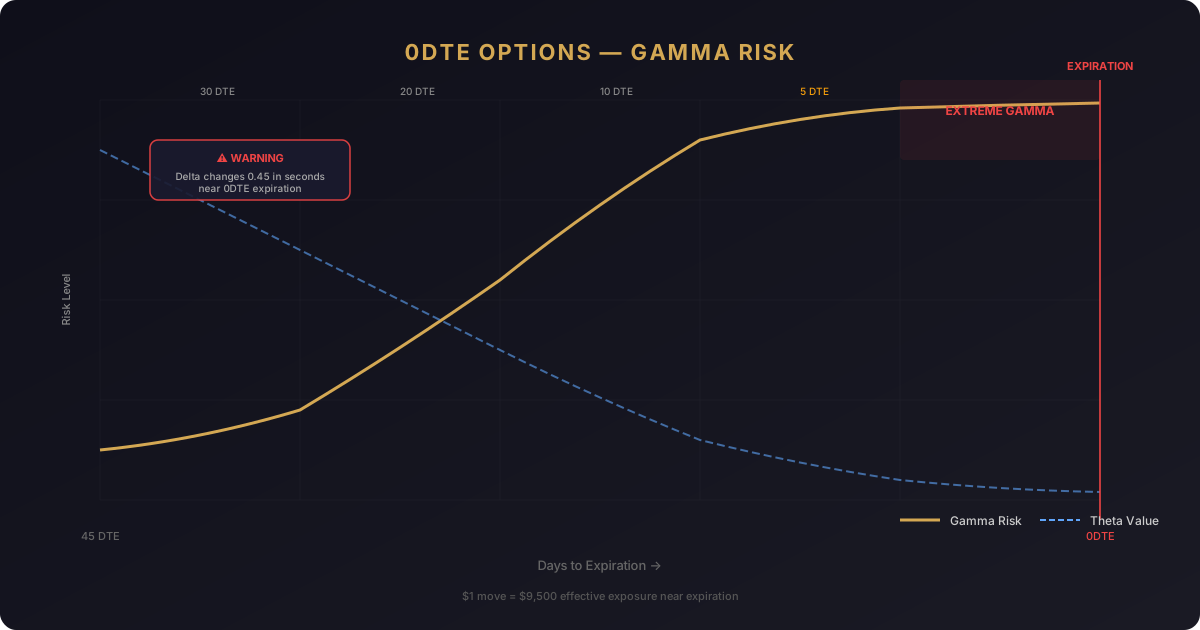
TL;DR: 0DTE options have extreme gamma risk — a $1 move in SPX can change an ATM option's delta by 0.45 in seconds, turning a $1,000 investment into $9,500 of directional exposure. Most retail traders lack the capital, speed, and gamma knowledge to trade 0DTE profitably.
What Is 0DTE Trading?
0DTE stands for zero days to expiration. These options expire on the same day they are traded, with many expiring at 4:00 PM EST alongside the market close. What started as institutional hedging tools has become a retail phenomenon — driven by social media, commission-free brokers, and the promise of fast money.
The appeal is obvious: why wait 30 or 45 days for theta decay when you can capture it in hours? But the math that makes 0DTE attractive is the same math that makes it lethal. The closer an option gets to expiration, the faster its gamma changes — and the faster you can lose everything.
Gamma Risk: The Silent Killer
Gamma is the rate of change in an option's delta for every $1 move in the underlying. With 0DTE options, gamma is extreme near the money strikes. A move that would cause a 5% delta shift in a 30-DTE option might cause a 50% delta shift in a same-day option.
When you buy a 0DTE option, you are essentially buying a lottery ticket with a built-in time bomb. The option's value can double in 20 minutes if the market moves your way — or it can go to zero in the same timeframe if it moves against you. The delta changes so fast that by the time you react, the opportunity is gone.
The Gamma Spike Reality
Near expiration, a $1 move in SPX can change an ATM call's delta from 0.50 to 0.95 in seconds. That means a $1,000 investment in the option behaves like $9,500 in the underlying — in either direction. Retail traders rarely understand this leverage until they are staring at a margin call.
For sellers, gamma risk cuts the other way. When you sell a 0DTE iron condor, your short strikes that looked safe at 9:30 AM can become deeply in-the-money by 3:45 PM with almost no warning. The adjustment window is minutes, not hours. For a deeper understanding of how gamma works, see our Options Greeks Explained guide.
Pinning Risk and MOC Orders
Pinning is one of the least discussed but most documented risks in 0DTE trading. When large open interest builds up at specific strike prices — particularly around round numbers like $500 or $600 — market makers must hedge their exposure. This creates a self-reinforcing dynamic that can trap traders.
If 50,000 traders buy $500 strike calls on SPX expiring today, market makers sold those calls and are now short gamma. To stay neutral, they must buy stock as SPX approaches $500. That buying pushes SPX toward $500. As expiration nears, this hedging demand can literally pin the index at or near that strike.
For traders who sold the $500 strike thinking SPX would stay below it, pinning is a nightmare. SPX sits at $500 all day, they think they are safe — then at 3:58 PM it drops to $499.50 and their short put expires worthless, but they missed the profit they could have made. Or worse, it spikes above $500 and they get assigned.
Research from the CBOE shows that pinning is more prevalent in 0DTE options than in any other expiration cycle. The concentration of MOC (market-on-close) orders at specific strikes creates measurable price effects in the final 30 minutes of trading, which is why understanding iron condor adjustments near expiration is critical.
The Theta Myth: Why Time Decay Fails You in 0DTE
Every options education course teaches you that theta decay accelerates as expiration approaches. And that is true — for options that are 30, 45, or 60 days out. But in 0DTE, the theta curve is so steep that it becomes nearly impossible to capture consistently.
The problem: theta decay is priced into 0DTE options from the open. When you buy a 0DTE option at 9:35 AM, the theta is already baked into the premium. You are not getting theta for free — you are paying for theta acceleration that has already occurred overnight and in the pre-market session.
Who Captures Theta in 0DTE?
The real theta advantage in 0DTE belongs to market makers who can gamma-scalp — buying and selling the underlying repeatedly as it oscillates around a strike, collecting small profits on each oscillation while the option price stays range-bound. Retail traders do not have the technology or capital to do this effectively.
Margin Requirements: The Trap
If you sell 0DTE options, your broker will require significant margin. Unlike buying calls where your max loss is the premium paid, selling naked 0DTE options can result in losses far exceeding your initial margin requirement.
Buying 0DTE
Max loss = premium paid. Simple. But roughly 80-90% of 0DTE options expire worthless on the day — most retail buyers are selling theta they never collect.
Selling 0DTE
Unlimited risk in theory, massive margin calls in practice. Not for beginners. Even small moves against you can trigger margin calls within minutes.
With the rise of 0DTE popularity, some brokers have tightened margin requirements specifically for these products. But gaps still exist, and a trader who gets caught on the wrong side of a big intraday move can receive a margin call for more than their account is worth.
Real 0DTE Blow-Up Examples
The internet is full of stories about traders losing everything on 0DTE trades. Most never get reported because the traders are embarrassed. But some become public:
- A trader on Reddit's WallStreetBets documented a $50,000 account reduced to $3,200 in a single week of 0DTE iron condor trades on SPX. The margin calls came faster than he could close positions.
- Several prop firm traders have reported blowing up funded accounts with 0DTE trades — prop firms that allow day trading see 0DTE as a way to quickly generate profits, but the volatility causes rapid drawdowns.
- Back in 2020, a well-known retail trader posted a video showing a single 0DTE SPX put trade that lost over $200,000 in under an hour when the market reversed sharply after a Fed announcement.
The common thread in all these cases: the traders underestimated how fast gamma changes near expiration, and they did not have the capital to survive the margin calls when positions moved against them.
Who Should NOT Trade 0DTE?
Avoid 0DTE if you:
- - Have less than $10,000 in your trading account
- - Cannot check positions continuously during market hours
- - Do not fully understand gamma and delta mechanics
- - Need the income from trading to cover living expenses
- - Trade with emotion rather than a defined plan
- - Are new to options (less than 1 year of experience)
Who might consider 0DTE:
- - Experienced options traders (3+ years)
- - Accounts with $25,000+ (PDT rule compliant)
- - Can actively monitor positions throughout the day
- - Understand gamma scalping and can execute it
- - Have defined risk rules and stick to them
- - Treating it as a small portion of overall strategy
The Bottom Line on 0DTE Options Risks
0DTE trading is not inherently bad — institutions use it every day to hedge positions. But for most retail traders, the risks are asymmetric. The house (market makers) has the technology, capital, and speed advantage. The theta you think you are capturing is already priced in. The gamma that moves against you can wipe out weeks of profits in an afternoon.
Before you trade 0DTE options, ask yourself: do you have real-time data, fast execution, sufficient capital, and a deep understanding of gamma mechanics? If the answer to any of those is no, you are likely the mark in someone else's trade. If you want to learn the fundamentals first, start with our Options Trading for Beginners guide. For broader risk management principles that apply to all options strategies, see our Forex Risk Management guide (the same core principles apply to options).
Know Your Limits Before Trading 0DTE
The most important thing you can do before trading zero-day options is to understand the math. If the Greeks are still new to you, spend time with our Options Greeks guide first. The difference between knowing your gamma and not knowing it is the difference between managing a position and watching it blow up.
Learn the Greeks First →Frequently Asked Questions
What are 0DTE options and why are they dangerous?
0DTE means zero-days-to-expiration — options that expire within the same trading day. They carry extreme gamma risk because a small move in the underlying causes massive swings in option delta, leading to rapid losses or gains that can exceed your position size.
What is gamma risk in 0DTE trading?
Gamma measures how fast an option's delta changes. In 0DTE options, gamma is extremely high near the money. A 1% move in the underlying can flip an option from being slightly in-the-money to deeply in-the-money, instantly doubling or tripling the loss. This is why traders can go from profitable to wiped out in minutes.
What is pinning risk with 0DTE options?
Pinning occurs when a popular 0DTE strike acts as a magnet for market makers who need to hedge their positions. As expiration approaches, the underlying can get stuck at or near a strike price, trapping traders on the wrong side. MOC (market-on-close) order imbalances from options hedging are a well-documented pinning driver.
Can retail traders profit from 0DTE options?
Some do, but the odds are stacked against most retail traders. Market makers have superior speed, technology, and hedging models. Retail traders collectively lose money on 0DTE trades due to bid-ask spreads, gamma scalping by institutions, and emotional decision-making under extreme volatility.
Final Thoughts
0DTE trading rewards those who understand gamma, have the capital to survive margin calls, and can actively manage positions throughout the day. For everyone else, it's a fast path to account destruction dressed up as a get-rich-quick scheme. Learn the fundamentals first. Understand your Greeks. Only then consider whether 0DTE has a place in your strategy — and even then, keep position sizes small.
About Andreas
I've been trading forex since 2009. Lost money early on like most traders, then spent years figuring out what works. Now I help others find tools and systems that actually speed up the learning curve.
Disclaimer: Trading options carries substantial risk. What I share works for me—your results depend on your discipline and risk management. Never trade money you can't afford to lose.