Fibonacci Retracements in Forex: Complete Trading Guide (2026)
Published April 24, 2026
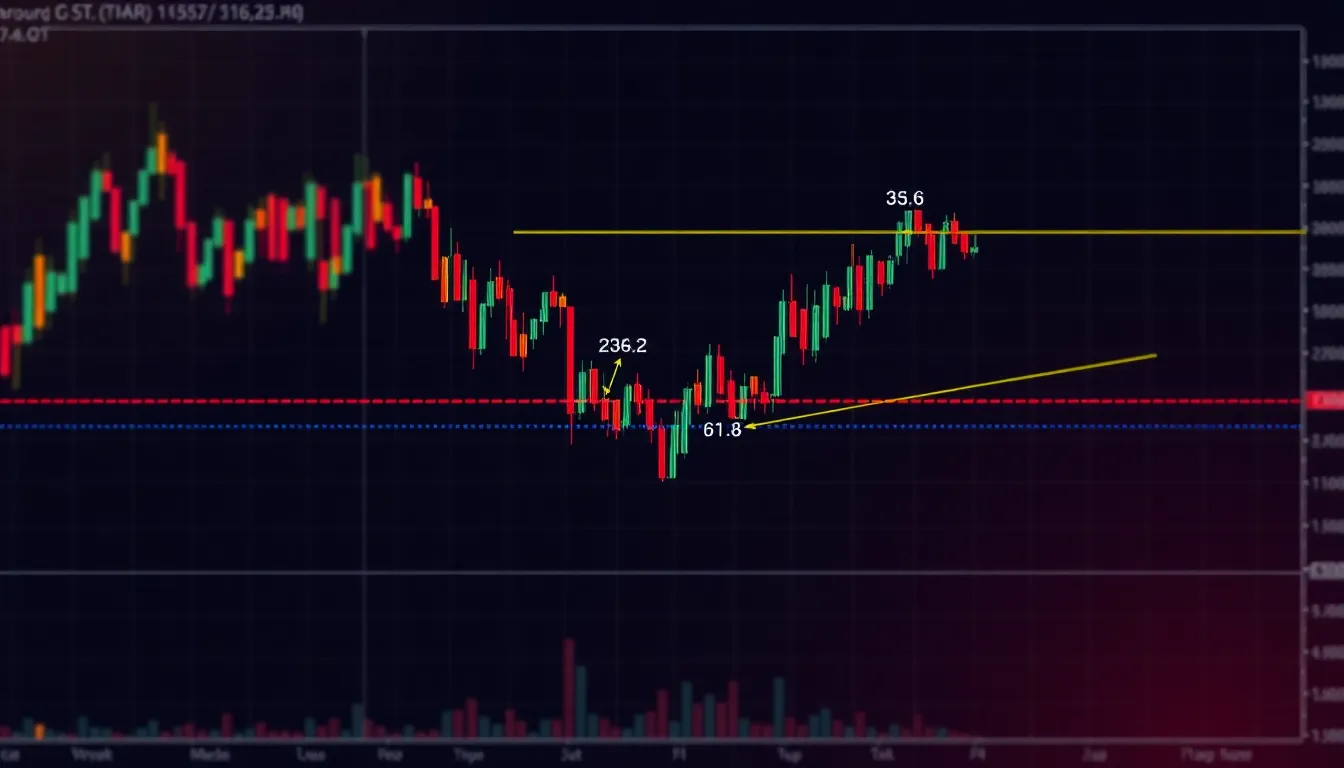
Fibonacci retracements are one of the most widely used tools in forex trading—and one of the most controversial. Purists will tell you it's based on mathematical truth. Skeptics say it's voodoo that works because enough people believe in it.
After 15 years of trading, my take: it doesn't matter why it works. What matters is that it does work. The reason is simple: if thousands of traders are watching the same 61.8% retracement level, their combined actions create real support and resistance—regardless of whether the golden ratio is mystical or coincidental.
TL;DR: Draw Fibonacci from recent swing high to low. Key levels: 38.2%, 50%, 61.8%. Wait for price to react at these levels with RSI or moving average confirmation. Look for Fibonacci clusters where multiple timeframes align (confluence).
What Are Fibonacci Retracements?
Fibonacci retracement levels are horizontal lines that indicate where support or resistance is likely to occur. They are based on the Fibonacci sequence—a series of numbers where each number is the sum of the two preceding numbers (0, 1, 1, 2, 3, 5, 8, 13, 21, 34, 55, 89, 144, etc.).
From this sequence, key ratios are derived: 23.6%, 38.2%, 50%, 61.8%, and 78.6%. The 61.8% ratio (called the "golden ratio"—each number is 1.618 times the previous) is considered the most significant.
Key Fibonacci Retracement Levels
| Level | Significance | Trading Use |
|---|---|---|
| 23.6% | Shallow retracement | Often in strong trends—weak reaction |
| 38.2% | Moderate retracement | Common pullback level—moderate support |
| 50.0% | Not Fibonacci—psychological level | Often acts as support/resistance |
| 61.8% | Golden ratio—strongest level | Major support/resistance—highest reaction rate |
| 78.6% | Deep retracement | Significant in volatile pairs—strong reaction |
Why Fibonacci Works in Forex
Here's the uncomfortable truth: Fibonacci works because of self-fulfilling prophecy, not because of mathematical perfection. When a trader sees price stall at 61.8%, they buy. When price bounces, they tell others. More traders watch. The level strengthens.
This is especially true in forex because the market is the largest, most liquid financial market in the world. With over $7 trillion traded daily, millions of traders using some form of Fibonacci analysis, the levels genuinely matter because of collective action—not cosmic mathematics.
The Real Reason Fibonacci Works
- Self-fulfilling prophecy: Millions of traders watch the same levels, creating real support/resistance through collective action
- Human psychology: People naturally look for patterns and make decisions at round numbers and ratios
- Institutional use: Banks and institutions use Fibonacci levels for their own trading, amplifying the effect
- Time-tested: After decades of use, these levels have become embedded in market behavior
How to Draw Fibonacci Retracement Correctly
Drawing Fibonacci correctly is more art than science, but there are rules that improve accuracy.
Step 1: Identify the Trend Direction
Before drawing Fibonacci, determine the trend direction using higher timeframe analysis. In an uptrend, draw from swing low to swing high. In a downtrend, draw from swing high to swing low. Always draw left to right, in the direction of the trend.
Drawing Fibonacci: Up vs Downtrend
| Market Condition | Draw From | Draw To | Look For |
|---|---|---|---|
| Uptrend | Swing Low | Swing High | Buy at pullback levels |
| Downtrend | Swing High | Swing Low | Sell at rally levels |
Step 2: Choose the Swing Points
Your swing points should be obvious pivots—places where price clearly reversed. Use the most recent major swing for short-term trading, or significant historical swings for longer-term analysis.
- For swing trading: Use the most recent swing high/low (last 1-3 weeks)
- For position trading: Use major swings from the last 1-3 months
- Avoid: Minor wiggles within a larger trend—these create noise, not signal
Step 3: Wait for Price to Reach Fibonacci Levels
Don't anticipate—wait for price to actually reach the level before looking for entries. Just because a Fibonacci level exists doesn't mean price will react to it. Watch for price action signals at the level: candles that reject, consolidation, or momentum indicators turning.
Fibonacci Confluence: The Key to Higher Probability Trades
Here's the secret most beginners miss: single Fibonacci levels are not enough. The magic happens when Fibonacci levels from multiple timeframes align—when the 61.8% retracement on the 4H chart matches the 38.2% on the daily chart, for example.
This is called "confluence"—and it's how you separate high-probability setups from low-probability noise.
What Creates Strong Confluence?
- Fibonacci level aligns with a horizontal support/resistance zone
- Multiple Fibonacci levels cluster together (e.g., 38.2% from one swing + 61.8% from another)
- Fibonacci level matches a key moving average (50 EMA, 200 SMA)
- 61.8% retracement matches a swing low/high from a higher timeframe
- RSI shows overbought/oversold at the same level (momentum confirmation)
When 2-3 of these align, you have a high-probability trade setup. When all 5 align, it's a prime entry.
How to Trade Fibonacci Retracements
Entry Strategy: Pullback Entries
The most reliable Fibonacci trades come from entering on pullbacks to the key levels (38.2%, 50%, 61.8%). Here's my step-by-step approach:
- Identify the trend: Price above 200 EMA = uptrend (look for longs), below = downtrend (look for shorts)
- Wait for a pullback: Price retraces to a Fibonacci level
- Check for confirmation: RSI approaching oversold (for longs) or overbought (for shorts)
- Look for price rejection: Bullish engulfing candle, pin bar, or doji at the level
- Execute: Enter on the close of the confirmation candle
- Set stop loss: Below the swing low (for longs) or above the swing high (for shorts)
Stop Loss Placement
Your stop loss goes beyond the Fibonacci level—not just beyond it, but beyond where the trade would be invalidated. For a long trade at 61.8%, your stop goes below the 78.6% level (or below the most recent swing low).
Never place a stop just "a few pips" beyond the level. Give the trade room to breathe while protecting you from a false breakout.
Take Profit Targets
Fibonacci doesn't tell you where to take profit—it tells you where to enter. For exit strategies, combine with:
- Previous swing high/low: Price often reverses at prior support/resistance
- Risk-reward ratio: At minimum 1.5:1, ideally 2:1 or better
- Moving averages: 50 EMA or 200 SMA as dynamic resistance
- Fibonacci extension levels: 127.2%, 161.8% as profit targets
Combining Fibonacci with Other Indicators
Fibonacci + RSI
RSI confirms momentum at Fibonacci levels. Buy when RSI shows oversold at 61.8% support.
Example: Price at 61.8% + RSI below 30 = high-probability long entry.
Fibonacci + Moving Averages
Moving averages confirm trend and act as dynamic support/resistance.
Example: 50 EMA at 38.2% level = strong confluence for long entry.
Fibonacci + MACD
MACD histogram shift confirms momentum change at Fibonacci levels.
Example: MACD crosses above signal line at 61.8% = momentum confirmation for longs.
Fibonacci + Support/Resistance
Horizontal S/R zones overlap with Fibonacci = strongest signals.
Example: 61.8% at a major horizontal support = confluence zone for longs.
Common Fibonacci Mistakes to Avoid
Mistake 1: Drawing Fibonacci in Both Directions
Some traders draw Fibonacci both ways and see levels everywhere. Pick one direction based on the trend. In an uptrend, only look for long entries at Fibonacci pullback levels.
Mistake 2: Entering Before Price Reaches the Level
Don't "predict" where price will go and enter early. Wait for price to actually reach and react at the level. Anticipation leads to losses.
Mistake 3: Using Fibonacci Without Confirmation
A Fibonacci level alone is not a trade signal. Always wait for price action (candle rejection) and/or an indicator confirmation (RSI, MACD) before entering.
Mistake 4: Ignoring Higher Timeframe Levels
A 4H Fibonacci level is weak if it contradicts a daily trend. Always check if your Fibonacci setup aligns with the higher timeframe structure.
Mistake 5: Overdrawing Fibonacci
Every swing you draw adds more levels, which creates confusion. Limit yourself to the most obvious 2-3 swings per chart. Fewer lines = clearer analysis.
Fibonacci on Different Timeframes
Fibonacci levels work on all timeframes, but certain levels are more significant on higher timeframes.
- Weekly chart: 61.8% retracements can take months to play out. Major levels for position traders.
- Daily chart: 38.2%, 50%, 61.8% all significant. Best for swing traders holding 1-5 day positions.
- 4H chart: All levels matter. Good for intraday swing trades within the daily trend.
- 1H/15min: More noise. Use only for fine-tuning entries, not for initial analysis.
My Fibonacci Trading Rules (Summary)
- Only trade Fibonacci in the direction of the higher timeframe trend
- Wait for price to reach the level—never anticipate
- Always add confirmation: RSI, MACD, or price action rejection
- Look for confluence: Fibonacci + S/R + trend line + indicator = high probability
- Use multiple timeframes: Daily for structure, 4H for entry, 1H for timing
- Stop loss goes beyond the Fibonacci level (at 78.6% or beyond the swing)
- Take profit at previous highs/lows or risk-reward target (minimum 1.5:1)
For a complete trading system that combines Fibonacci with other indicators, check out our candlestick patterns guide and RSI indicator guide.Forex Probe combines Fibonacci levels with RSI, MACD, and Stochastic for multi-confirmation entries.
Frequently Asked Questions
What are the key Fibonacci retracement levels?
The most important Fibonacci retracement levels are 23.6%, 38.2%, 50%, 61.8%, and 78.6%. Of these, 38.2%, 50%, and 61.8% are the most significant for forex trading. The 61.8% level (the golden ratio inverse) is considered the strongest support/resistance.
How do you draw Fibonacci retracement correctly?
For an uptrend: click from swing low to swing high (left to right). For a downtrend: click from swing high to swing low. Always draw from left to right in the direction of the trend. Use the most recent major swing as your reference point.
Does Fibonacci actually work in forex trading?
Fibonacci works because many traders use it—the levels become self-fulfilling prophecy. When hundreds of traders watch the same 61.8% level, their combined buying/selling creates real support and resistance. This is why Fibonacci works on major currency pairs with high liquidity.
Should I use Fibonacci alone or with other indicators?
Never use Fibonacci alone. The levels are too subjective and produce false signals. Combine with trend direction (moving averages), momentum (RSI), and especially support/resistance zones where multiple Fibonacci levels cluster together (confluence).
What timeframe is best for Fibonacci trading?
4H and Daily charts are most reliable for Fibonacci. The higher the timeframe, the stronger the Fibonacci levels. Weekly Fibonacci retracements can take months to play out but offer the highest probability setups.
About Andreas
I've been trading forex since 2009. Lost money early on like most traders, then spent years figuring out what works. Now I run multiple trading operations and help others find tools and systems that actually speed up the learning curve.
Disclaimer: Trading forex carries substantial risk. I've lost accounts, made mistakes, and learned from both. What I share works for me—your results depend on your discipline and risk management. Never trade money you can't afford to lose.